HomePodcastFree toolsEventsThemes
EpisodesGuestsGuest guide
Think smarter.Lead better.Deliver more.
PodcastEpisodesGuestsGuest guide
EventsUpcomingPast
ExploreHomeFree toolsThemesPeople
AboutAbout Build Your Edge Build Your Edge Jeremy Burns — Co-Founder & Host Jack Cole — Co-Founder & Host

© 2026 Build Your Edge. All rights reserved.

HomePodcastFree toolsEventsThemes
EpisodesGuestsGuest guide
Coming soon

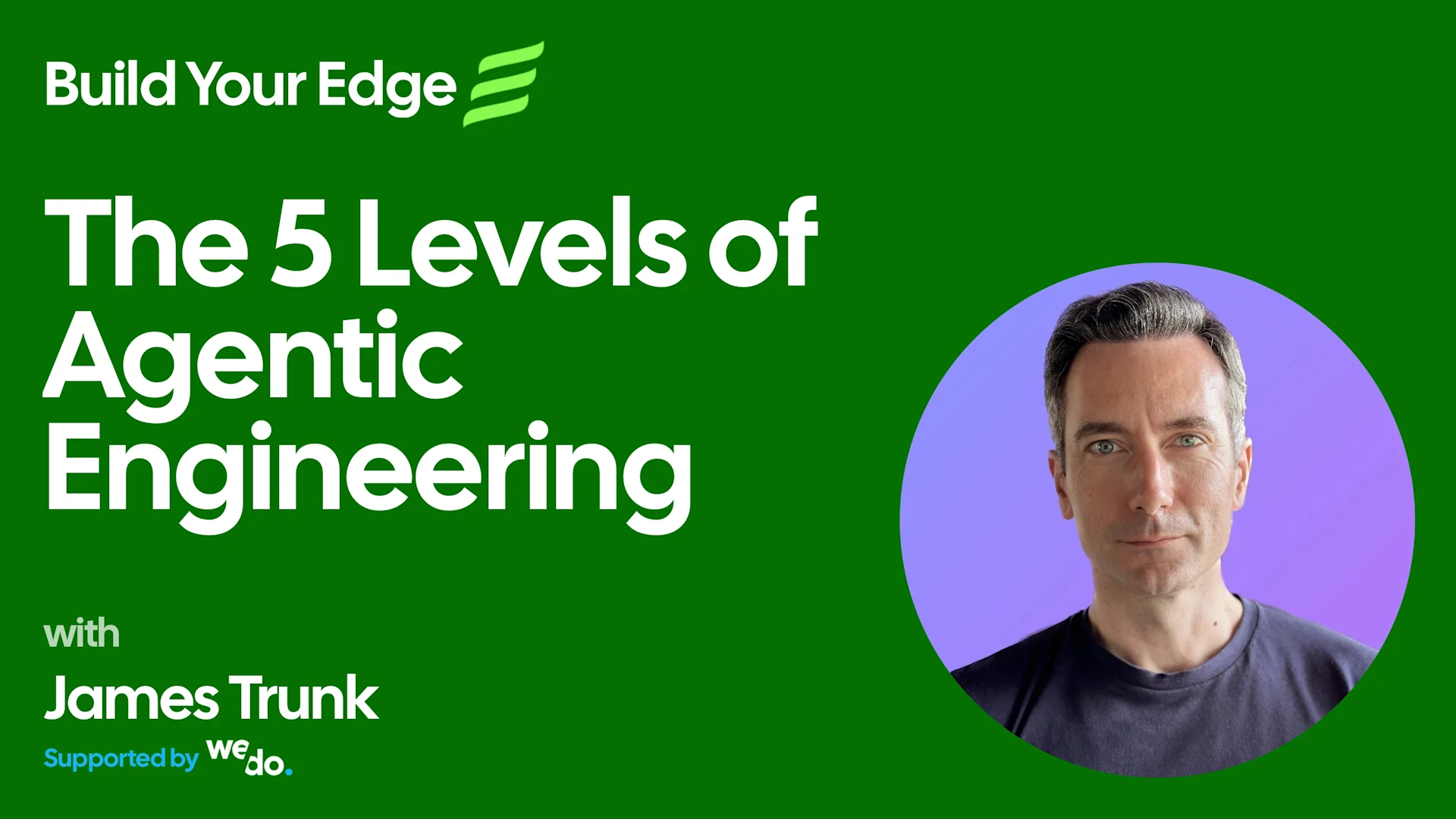
The 5 Levels of Agentic Engineering

A CTO's framework for going from vibe coding to world-class.

JTJames Trunk· CTO at Dotfile
AI and Technology
The 5 Levels of Agentic Engineering

About the guest

James Trunk

James Trunk

CTO at Dotfile

James has 25+ years of experience building high-performance teams and launching successful products. He has a proven track record transforming startups into scale-ups through process innovation, strategic product development, and people-first leadership. James has built a bank from scratch, open-sourced a world-class architecture, advised leadership teams, coached executives, and sat on multiple boards.

LinkedInFull profile

Episode summary

AI can now write code, generate documents, debug issues, and produce architecture in a matter of seconds. For an industry where technical skill has long been the clearest path to career value, that raises an uncomfortable question: if AI can do the parts of the job that once made you valuable, what actually becomes the differentiator?

In this episode of Build Your Edge, host Jack Cole is joined by James Trunk, newly appointed CTO at Dotfile — a global business verification (KYB) platform — and former VP of Engineering at Griffin Bank, where he grew the engineering team roughly tenfold over five years. James brings a rare combination of hands-on technical depth and leadership experience to a conversation that goes well beyond the usual "AI will change everything" talking points.

The Framework: Five Levels of Agentic Engineering

At the heart of this episode is a practical model James has developed for understanding where individuals and teams actually sit on the AI adoption curve:

  1. Vibe coding – simple prompts, minimal involvement, purely trusting the output
  2. Prompt engineering – learning to guide the model with clearer, more structured instructions
  3. Context engineering – understanding context windows, context rot, and how to feed an agent the right information at the right time
  4. Harness engineering – using skills, hooks, and deterministic checks to enforce quality rather than hoping for it
  5. Specification engineering – keeping humans in the loop throughout a feature's lifecycle, from problem definition through to shipped code

James walks through each level with real examples, explains the common traps at each stage (including the "witch doctor" pitfalls of over-engineered prompting), and shares how long it realistically takes to progress through them.

What Else Is Covered

Beyond the framework, Jack and James dig into a wide range of practical, currently-live questions facing engineering leaders and job seekers alike:

  • Hiring in the agentic era – what strong AI-related interview questions actually look like, why "show me, don't tell me" beats buzzword-checking, and how to spot candidates who understand the code an agent produced versus those who simply accepted it
  • Shrinking teams, not shrinking ambition – why James believes feature teams will get smaller, why that doesn't mean mass layoffs, and how smaller teams enable more parallel learning across an organization
  • Generalist vs. specialist – why narrow technical specialization is becoming riskier, and how domain expertise (fintech, healthcare, etc.) still commands a premium
  • Measuring productivity and ROI – why Goodhart's Law makes naive AI metrics dangerous, and what James actually looks at instead
  • The psychological cost of context switching – how flow state is changing for engineers juggling multiple parallel agent sessions, and what leaders can do to protect focus and wellbeing
  • What "high performance" really means now – James's view that speed of learning, not raw output, is the real marker of a high-performing team
  • Career advice for junior engineers – how to build "taste" in a world where agents can produce average output instantly, and why junior engineers can't simply skip the reps

Key Takeaway

Despite the episode's AI framing, the throughline is fundamentally human: adaptability, communication, quality judgment, and keeping people genuinely in the loop remain the real differentiators — for individuals and for the teams and businesses they build.

About the Guest

James Trunk is CTO at Dotfile, a global business verification platform focused on Know Your Business (KYB) compliance for financial institutions and regulated industries. He previously spent five years as VP of Engineering at Griffin Bank, where he helped build the company's engineering, design, and product functions from an early-stage team of five or six into a mature organization — including an in-house onboarding and financial crime function that laid the groundwork for his current role at Dotfile.

Resources

James has shared a slide deck summarizing his five-level agentic engineering framework — a handy reference if you want to revisit the model without re-listening to the full conversation. Dotfile is currently hiring for full-stack engineering and product management roles; details are in the episode.

As always, don't forget to download this week's free digital asset at buildyouredge.org and put today's conversation into practice — retention jumps significantly when you apply what you've learned rather than just listening.

More on AI and Technology

Other episodes covering the same ground.

The Hidden Costs of AI Nobody Talks About

The Hidden Costs of AI Nobody Talks About

What we might lose while chasing the benefits.

Eloisa Tovee · 93 mins

Listen or watch
All AI and Technology episodes

Keep going

Next episodeWhy We Started Build Your EdgeJack Cole · 41 mins
All episodes